I wanted a gaming platform that assumed I was a person with a real-world budget, a machine that is not always new, and friends who do not all own the same games. Great games do not have to cost $70. A lot of the best PC games of the last twenty years are free, or cheap, and sitting in a forum thread from 2014, a GitHub release page, and a wiki that assumes you already know what a total conversion
By Ryan Schumacher Published
Hey. I'm Ryan. I built PlayBound and I run it with the help of a few friends because I got tired of sending them folders filled with tabs.
WHAT IS PLAYBOUND?
PlayBound is a curated catalog plus a desktop launcher for free games and paid games that stay at $15 or less.
We find them. We install them. We play them. We package mods into editions that add things like multiplayer and controller support. Then we make "download the thing and get your friends in the same server" a short sentence instead of a weekend project.
The tagline is Discover. Play. Connect. That is also the product, in order.
Great games do not have to cost $70. A lot of the best PC games of the last twenty years are free, or cheap, and sitting in a forum thread from 2014, a GitHub release page, and a wiki that assumes you already know what a total conversion is. I got tired of sending friends a folder of tabs. So I made the place I always wanted to open on a Friday night.
WHY DID I BUILD PLAYBOUND?
I wanted a gaming platform that assumed I was a person with a real-world budget, a machine that is not always new, and friends who do not all own the same games.
I wanted:
A small catalog I could trust, not 40,000 rows of shovelware
Free and under-$15 as a permanent shelf, not a 48-hour sale sticker
A launcher that does the unglamorous part: engines, dependencies, editions, mods, and auto-updates
A way to play together that does not die because someone is behind home internet
No bundled junk, no paywall in front of the catalog, no selling my data to pay for the lights
I did not want another storefront competing with Steam. Steam is fine. I wanted the other shelf. The games that already exist, that communities already keep alive, that you cannot find unless you already know the name of the emulator, the fork, and the one working download mirror.
THE PLAYBOUND PHILOSOPHY
Parts of the industry got very good at taking time and money. Live-service economies, paid competitive advantages, loot boxes. Meanwhile independent developers, open-source maintainers, and community teams have been building extraordinary games that are free or remarkably affordable.
The problem is not that the games are missing. The problem is discovery, and then the install.
Finding them usually means forum archaeology, compiling a GitHub repo, and configuring dependencies by hand. That scavenger hunt is a rotten way to find something to play tonight. PlayBound is the map, the test play, and the one click.
A few rules I will not bend:
Fair value. Free or high-value. Optional cosmetics, battle passes, and extra campaigns are welcome when the game you launched is already the game. We will not list titles that sell competitive advantage, disguise a trial as free, or charge you again to finish the core experience.
Hand-curated, on purpose. We do not inflate the library. About 142 games are up right now. Every one is tested and played before it is added. If it is shovelware, it does not get a spot.
Preservation is a feature. Open-source engines, standalone fan projects, private servers, curated mods. Legendary games stay alive because communities refuse to let them go. Where a community build or freely redistributable data is at risk of vanishing, we mirror it ourselves so a dead link does not take the game with it.
Privacy. No bundled spyware. No selling your data.
THE PLAYBOUND BAR
Every game has to clear four points. If it misses, it stays out.
Worth the cost. Free and high-value. Good developers deserve to be paid. We will not list pay-to-win, fake-free trials, or "pay again to finish."
Ready to play. Playable and satisfying today. It can be unfinished. It cannot be unfun. Prototypes and "trust us, the real game is coming" do not make the cut.
Tested by PlayBound. We install it, launch it, and play it. A store-page claim is not the same as a game we will put in front of you. We have spent hours building definitive editions and making multiplayer work for that reason.
That one thing. Every game needs the one thing we would excitedly tell a friend about. Mechanics, world, soundtrack, community, the way it puts people in a room. If we cannot name it, it does not go in.
New curated games land every week. Morrowind is the newest pick as I write this, $5.99 on GOG: get off the boat, ignore the prophecy, and get wonderfully lost. Own that copy and you unlock two community editions on PlayBound — a modern open-source remaster, and one that adds real multiplayer on top of the higher-end engine. We offer you dedicated servers to play on with your friends.
THE CATALOG
Think of the site as a magazine that also installs the games.
You will see free titles (Xonotic, Mindustry, OpenRA, Beyond All Reason, HoloCure, OpenArena, 0 A.D., and a lot of others) next to paid ones. Morrowind at $5.99 is the example I keep using, because it is the whole thesis on one island.
And we watch the stores. Epic, Steam, GOG, and Prime Gaming run limited 100% free-to-keep promotions. We aggregate those so you do not have to refresh four storefronts. Free weekends are not keeps, and we will say so if we mention one.
We do not sell these games. If Morrowind costs $5.99, you buy it on GOG. PlayBound is the catalog, the test, the editions, and the launcher. Ownership of the licensed files is still yours.
EDITIONS
An edition is a different way to play the same game. It is not a skin. It is not a DLC checkbox. It is its own install, with its own community and its own verification status.
Open a game page and you will see something like: 3 ways to play The Elder Scrolls III: Morrowind. Each has its own install, community, and verification status.
A lot of the games we care about are not one executable. They are a master copy — the licensed data, or the official release — plus a pile of engines, forks, emulators, and community servers that use those files. If you have ever installed Morrowind, then OpenMW, then TES3MP, then argued about MCP and MGE XE, you already understand editions. You just suffered through them in the wrong order.
On PlayBound, the game page is the umbrella. The editions are the actual ways to launch.
Morrowind, as a concrete example. Owning Morrowind (the GOG or licensed PC copy) unlocks the data files. PlayBound does not sell that copy. Once you own it, you pick an edition and install it from the header or the Install tab.
OpenMW (Modern Remaster), the default. A modern 64-bit open-source engine recreation. Widescreen, controller support, uncapped performance. Community verified. This is the one I hand most people. It is single-player, like the original.
TES3MP. Full co-op and persistent server sync, built on OpenMW. Same island, other people in your ash storm. A separate edition because it is a separate install and a separate community.
Classic GOTY (Original Engine). The 2002 Bethesda Gamebryo executable, for people who want Morrowind Code Patch and MGE XE and already know the ritual. Official.
The original game is single-player. Multiplayer is not a checkbox on the official executable — it is a community edition that still needs a legal copy of the data. That is why the page talks about a master copy unlocking editions and mods. You buy the game once. You choose how to play it.
Star Wars Galaxies, as the other kind of example. SWG has no official live service anymore, so the game you are choosing is a community galaxy. Editions here are different servers and different philosophies:
A SWGEmu-style Pre-CU preservation galaxy
An NGE-focused later-era community
A Pre-CU restoration "what could have been" community
You are not picking a graphics preset. You are picking a community and an era. Each one has its own install and its own verification status, and some are still marked untested. We say so out loud.
How to think about it:
The licensed game or official data is the game (master copy). Example: Morrowind GOTY on GOG.
A different engine, fork, server, or official executable is an edition. Example: OpenMW vs TES3MP vs Classic.
An add-on that sits on top of an edition is a mod. Example: a 0 A.D. balance pack, an OpenLara shareware level pack.
If two installs cannot safely share a folder, they are editions, not mods.
You will see this pattern on OpenRA (classic vs Combined Arms vs Tiberian Dawn HD), OpenLara (browser vs desktop native), HoloCure (vanilla vs multiplayer), EverQuest (Live vs Project Quarm vs Project 1999), and Wolfenstein: Enemy Territory (ET: Legacy vs official vs TrueCombat). Same idea every time: one catalog row, several honest ways to play.
MODS
Mods are packageable add-ons for a title you already have a way to run.
We do not scrape the entire internet and dump untested files on you. We package the ones we are willing to install ourselves: community balance packs, legal shareware data, map packs, UI scale packs, controller layouts, engine tools that people actually use.
On the site they look like small cards under the game. In the launcher they install in one click, the same way an edition does. Total conversions and custom map packs are first-class, not a zip file we hope you extract into the right directory.
If a "mod" is actually a whole other multiplayer universe, it is usually an edition. TES3MP is that. A 30MB 0 A.D. balance pack is a mod.
THE LAUNCHER
The desktop launcher is the unglamorous half of PlayBound, which means it is the half I care about most.
It is open source, lightweight, and boring on purpose. No bloat. No DRM wrapper. No extra store currency.
What it actually does:
One-click installs for the game, the edition, and the mods
Downloads and dependencies, so you are not hunting a specific Visual C++ year
Updates from official developer releases. We are not hosting a shady mirror of someone else's executable and calling it convenience
Editions as first-class installs, so OpenMW and Classic GOTY are not fighting over the same folder unless they are supposed to
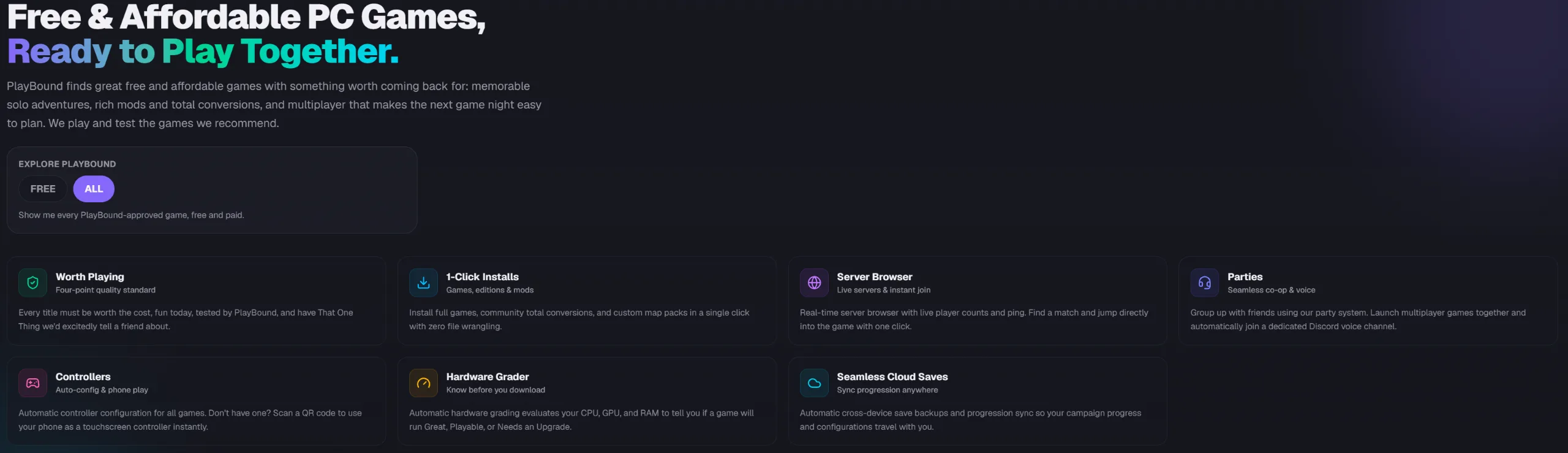
Hardware grading before you burn an evening: Great, Playable, or Needs an Upgrade, based on your CPU, GPU, and RAM. Beyond All Reason can melt a machine. Mindustry will run on the laptop in the closet. We tell you which is which
Cloud saves for progression and configs, so a dead laptop does not eat the Mindustry map you refuse to abandon
Controller auto-config, so you enter the game with your pad already set up
Your phone as a controller, when you do not have one to hand
Paid games still go through their real store. We do not sell Morrowind. We stop the evening from dying in a readme.
If you already own the game, sign in, add it, and install the PlayBound edition from the header or the Install tab.
PLAYBOUND CONNECT
A catalog you browse alone is just a prettier folder. Connect is how it becomes a club, and the club starts with a party.
You start a party. You pick a game. You can launch a Discord channel that everyone connects to in one click, or use the built-in text chat. You hit Join Game. Connect puts everyone in the same place. That is the whole move.
Most home internet cannot accept inbound game traffic. "What IP do I host." "Forward these ports." "Why am I in a different instance." The usual Friday night failure modes. Connect hosts the room on a public server and every player connects out. No port forwarding. No host migration. No hoping someone's NAT cooperates.
For a lot of official online games we just coordinate the party. Their network stays theirs: presence, ready-up, launch. We are not replacing their multiplayer. We are getting your friends into it.
The part I am proudest of is the other pile: games that never had real online in the first place, or whose multiplayer master server has died.
A bunch of titles we care about only ever shipped with LAN support, or a "type this IP" box, or local-network discovery that stops at the living room. They look for friends on the same switch and give up. We ran those through PlayBound's virtual network. Your party shares one private network, even if you are in four different houses. The game's own LAN browser or direct-IP join sees everyone as local. Same executable. Same discovery. It just thinks you are on the same LAN.
That is how a LAN-only night works when nobody can come over. Hedgewars, OpenTTD, OpenRA, Luanti, Mindustry, 0 A.D., TES3MP Morrowind, and more. A couple still need one in-game join step — Hedgewars wants the address from its own menu. Most of them, you hit Join Game and you are in.
Around the party:
A real-time server browser with live player counts, if you would rather jump on a public community server than host
Custom party lobbies, so the same group can ready up, chat, and launch together (voice too, if Discord is linked)
Per-game Discord channels, so Morrowind players end up in #openmw
LAN Party Favorites is the collection I point at when people are actually coming over — or when they are not, and the virtual LAN has to do the job. Xonotic, couch karts, OpenRA, hedgehog artillery, and a train tycoon for the friend who does not PvP. All free. Pizza is on you, or on four separate couches. Same party either way.
EVENTS
Connect gets people into the same game. Events are how you tell the rest of PlayBound when that is happening.
There are two kinds.
Game Nights are the simple one, and the one I want people using this week. You pick a game. You pick a time. You hit announce. It shows up on PlayBound so other people can see it, join the party, and actually turn up. No form with seventeen fields. No waiting for a moderator to approve your gathering. Game, time, done.
Use it for "OpenRA at 8," "Mindustry factory night," "TES3MP, get off the boat together" — whatever your group already does in Discord at 11pm, except now it has a clock on it and a door other players can walk through. When the time hits, Join Game still does the Connect work: a hosted room, or the virtual LAN if the game only ever spoke LAN or direct IP.
Tournaments are the structured version of the same idea. Same bones; a game, a time, an announcement, plus a bracket. People show up to compete, not just to mill around in a lobby. Brackets are automated. If your group wants a winner before the pizza is gone, this is that. If you just want bodies in a server, make a Game Night.
You will see both on the Events page, next to any public parties that are already live. Open a Game Night when you want company. Open a Tournament when you want a ladder. Either way the party is the room, and Connect is how everyone lands in the same one.