Other ways to play
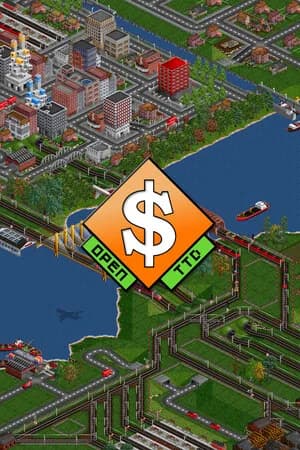
Separate OpenTTD build with extra signals, programming, and map tools. Installs beside vanilla, not as a NewGRF.
GenreSimulationStrategy
FeaturesControllerOnline Multiplayer
CommunityCommunity Verified
Build a transport empire, one rail at a time.
Simulation / Strategy · 2004 · ~200 MB · Open Source (GPL-2.0)
That One Thing
A single misplaced railway signal can bottleneck an entire nation's industrial output, and fixing it is strangely therapeutic.
OpenTTD is a free and open-source transport simulation game based on Transport Tycoon Deluxe, originally released in 1995. The project takes the classic transport-management formula and expands it into a highly customizable sandbox where players build and operate railways, road networks, shipping routes, and air connections while attempting to turn a small transportation company into an industrial empire.
The basic idea is wonderfully straightforward: move things from where they are produced to where they're needed, and make money doing it.
Cities need goods. Factories need resources. Industries produce cargo. Airports need passengers. Your job is to connect all of those pieces with an efficient transportation network.
What starts as a single bus route or short train line can gradually become an enormous logistical machine spanning an entire procedurally generated map.
Rail is where OpenTTD's obsessive side really starts to emerge. Building a railway is easy. Building one that handles dozens of trains without creating traffic jams, bottlenecks, deadlocks, or absurdly long waiting times is considerably harder. Players can construct complex junctions, signaling systems, multi-track corridors, transfer stations, and enormous hubs that make the entire map function like one interconnected network.
Roads, ships, and aircraft provide completely different logistical challenges. A successful company might eventually operate hundreds of vehicles simultaneously, with routes carefully optimized around cargo production, capacity, distance, and travel time.
The simulation also has a satisfying sense of progression. Technology improves as the game advances through different eras, introducing faster trains, larger aircraft, improved ships, and more advanced vehicles. Your transportation network therefore evolves from a handful of primitive routes into a sprawling modern infrastructure system.
But OpenTTD isn't only about recreating the original game. Its open-source development has allowed the community to dramatically expand it through new graphics, vehicles, maps, scenarios, gameplay settings, AI competitors, and other modifications. Players can customize the experience to an extraordinary degree, including altering economic rules, map generation, vehicle behavior, industries, and more.
Multiplayer is another major strength. Multiple companies can compete on the same map, turning what would normally be a solo optimization puzzle into an economic and logistical competition.
The game's presentation remains deliberately old-school, but that's part of its appeal. Beneath the simple graphics is a simulation capable of supporting incredibly elaborate transportation systems.
And because OpenTTD is open source and free, the entire experience is available without the usual restrictions associated with commercial simulation games.
Checking…
Minimum Requirements
1 GHz CPU · 1 GB RAM · Any GPU · 500 MB storage
Recommended Requirements
2 GHz CPU · 4 GB RAM · Any GPU · 1 GB storage
Published by the game's own developers.
Yes, entirely. OpenTTD is open-source under GPL-2.0 with no purchases, subscriptions or advertising. The free base graphics set means you no longer need the original Transport Tycoon Deluxe files.
No. OpenTTD ships with its own free graphics, sound and music sets, so it is a complete standalone game. You can use the original files if you own them, but it is not required.
Yes. OpenTTD has been in continuous development since 2004 and continues to receive regular releases, making it one of the longest continuously maintained games in existence.
BaNaNaS is the official in-game content service. It lets you download vehicle sets, industry chains, AI opponents, scenarios, heightmaps and graphics replacements directly inside the game, from a very large community library.
Yes, supporting dozens of simultaneous players on public or private servers, either cooperating on one company or competing as rivals. Live server and player counts are shown on the OpenTTD servers page.
OpenTTD is about transport networks between existing towns; Cities: Skylines is about designing and zoning a city itself. If you enjoy the traffic and logistics part of Skylines most, OpenTTD goes far deeper on exactly that.
Separate OpenTTD build with extra signals, programming, and map tools. Installs beside vanilla, not as a NewGRF.
Looking for the base game?
OpenTTD has an overview, reviews, guides, and discussions covering every edition.