Walk into Tamriel before the roads had guardrails.
That One Thing
Crawling through a pitch-black dungeon with three hit points left, listening to monster groans behind a locked door while frantically searching for a safe room to rest.
2 ways to play The Elder Scrolls: Arena. Each has its own install, community and verification status.
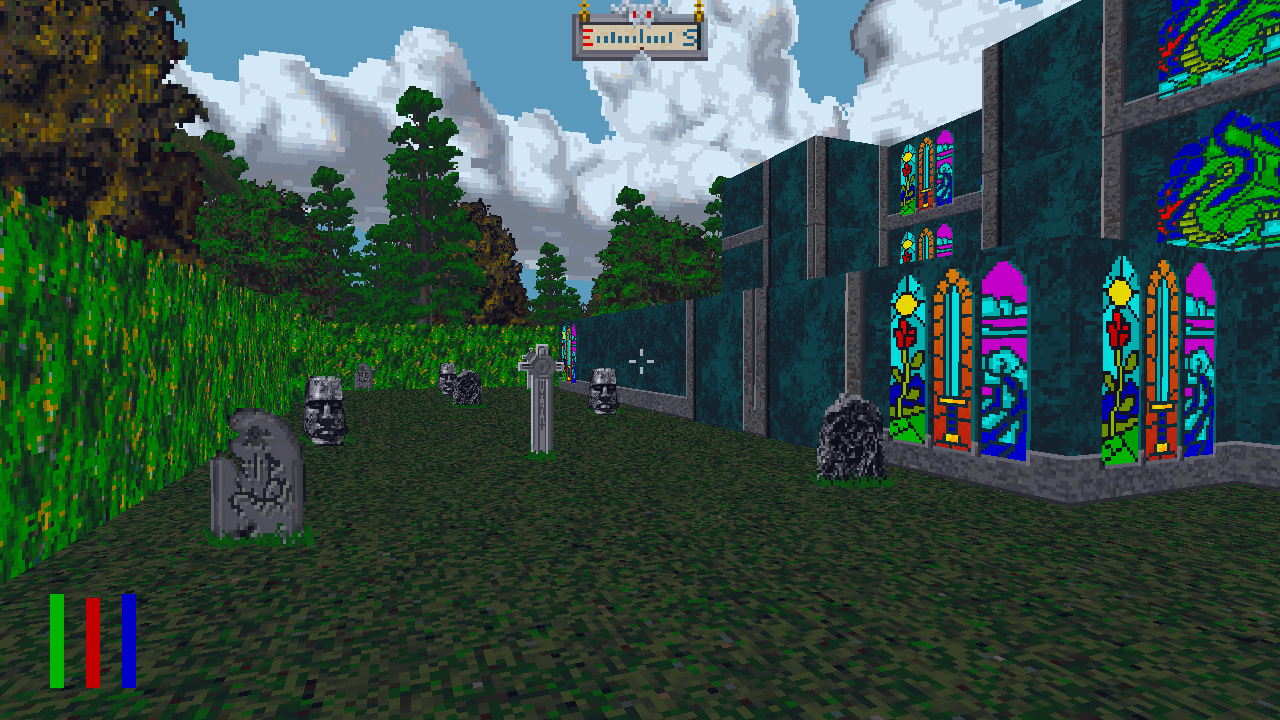
Modern open-source C++ engine reimplementation for TES: Arena.
The Elder Scrolls: Arena is the game that started Bethesda's legendary Elder Scrolls series, originally released for DOS in 1994. Long before Morrowind, Oblivion, or Skyrim, Arena introduced the enormous fantasy world of Tamriel and established many of the ideas that would eventually define the series: open-ended character development, sprawling exploration, first-person combat, enormous dungeons, guilds, magic, and the freedom to approach the world however you wanted.
The premise is classic Elder Scrolls: the Imperial Battlemage Jagar Tharn betrays Emperor Uriel Septim VII, imprisoning him in another dimension and assuming his identity. The player is tasked with escaping captivity, recovering the Staff of Chaos, and ultimately freeing the Emperor. But the main storyline is only a fraction of what makes Arena interesting.
The game's real achievement is its sheer scale. Arena was designed to give players the impression of an entire continent to explore. Towns, wilderness, dungeons, inns, shops, temples, guilds, and countless procedurally generated locations make Tamriel feel almost absurdly large for a game released in 1994. You can spend hours wandering without making meaningful progress toward the main quest—and that's part of the appeal.
Character creation is similarly flexible. Players choose from a wide range of classes with different strengths, weaknesses, skills, and equipment restrictions, while the game's magic and equipment systems give you plenty of room to experiment. The result isn't as refined as later Elder Scrolls games, but you can already see the series' obsession with letting players build characters that feel like their own.
Combat is considerably more archaic than what modern players might expect. Attacking involves mouse movements rather than simply clicking a button, dungeons can be confusing labyrinths, and the interface takes genuine adjustment. Arena is not a game that holds your hand. Its age is obvious, and part of playing it today is accepting that you're dealing with the design conventions of early-1990s PC RPGs.
That friction is also part of its charm. Arena feels like a game from a period when developers were still figuring out how much freedom a computer RPG could give the player. It is ambitious to the point of being ridiculous, and sometimes that ambition gets the better of it.
The best part is that Arena is officially available for free from Bethesda. You don't need to track down an abandoned physical copy or rely on questionable downloads to experience the beginning of one of gaming's most important RPG franchises.
We include Arena for the same reason a museum keeps first drafts. It is not the best Elder Scrolls game and we are not going to pretend it is — but it is the one where the series' whole design philosophy shows up fully formed, thirty years ago, and Bethesda gave it away rather than reselling it. That deserves a proper entry rather than a footnote.
Great if you want
Look elsewhere if
Checking…
Minimum
Windows, macOS or Linux with DOSBox · any CPU from the last two decades · 512 MB RAM · any GPU · 100 MB storage · this is the 1994 DOS release, so DOSBox does the work
Recommended
DOSBox Staging on a modern PC · any modern CPU · 1 GB RAM · integrated graphics are plenty · 100 MB storage · raise the DOSBox cycle count if movement feels sluggish
Yes. Bethesda released it as freeware in 2004 to mark the series' tenth anniversary, and still hosts the download themselves. It is also free on Steam and GOG.
In practice, yes. Arena is a DOS game, and without DOSBox it either refuses to run on modern Windows or runs at an unusable speed. The GOG release bundles a pre-configured DOSBox if you would rather not set one up.
Daggerfall is the better game and is also free. Play Arena if you are specifically interested in the series' origins; play Daggerfall, ideally through Daggerfall Unity, if you want a genuinely engrossing old Elder Scrolls game.
An open-source reimplementation of Arena's engine with modern rendering and controls, in active development. It is promising and is progressing quickly, but it is not yet complete, so the original freeware release remains the way to actually finish the game.
The main quest runs roughly thirty to forty hours, and the world is effectively endless because most of it is generated. Most players see what the generator has to offer well before exhausting it.
No. OpenArena is a free Quake III-style arena shooter and shares nothing with this game but the word Arena.
No. The Elder Scrolls: Arena is a single-player game, so there is no multiplayer mode to join or host.
Community
Official Discord
Talk directly with the The Elder Scrolls community.
Join Official Discord ↗
PlayBound Discord
Chat with PlayBound players in #tes-arena.
Join #tes-arena ↗
Solved this in Discord? Post the fix here so the next player can find it.
Nothing scheduled yet. Bring your friends together for a game night.
Create eventSign in to publish a community event, or start a party and play now.
Start a party →2 ways to play The Elder Scrolls: Arena. Each has its own install, community and verification status.
Modern open-source C++ engine reimplementation for TES: Arena.
Featured in
A PlayBound controller profile is being tested for this game. You can choose the preview in the Windows launcher; its layout may still need tuning.
How PlayBound Controls worksDefault bindings for every input method The Elder Scrolls: Arena supports. These are the game's own defaults — anything you have remapped will differ.
Arena has no built-in key rebinding; remap with DOSBox's mapper (Ctrl + F1). Most actions have both a mouse icon and a key.
Default keyboard and mouse bindings.
Mouse and keyboard.
| Action | Default input |
|---|---|
| Move forward / backOr left-click with the up/down arrow cursor | Up / Down Arrow |
| Turn | Left / Right Arrow |
| Sidestep | Ctrl + Left / Right Arrow |
| JumpRight-click while holding left mouse also jumps | J |
| Standing jump | Shift + J |
| Running jump | Up Arrow + J |
| Action | Default input |
|---|---|
| Attack | Hold Right Mouse and move the mouse |
| Cast spell | C |
| Recast spell | Shift + C |
| Draw or sheathe weapon | A |
| Action | Default input |
|---|---|
| Interact | Left-click with the X cursor |
| Identify | Right-click with the X cursor |
| Steal or pick lock | P |
| Action | Default input |
|---|---|
| Use item | U |
| Character sheet | F1 |
| Equip item | Double-click |
| Drop item | D |
| Action | Default input |
|---|---|
| Logbook | L |
| Rest | R |
| Player status | S |
| Automap | M |
| Continental map | Shift + M |
| Options menu | Esc |
| Action | Default input |
|---|---|
| Frame rate counter | N |
| Show position | F2 |
| Damage notification style | F3 |
| Toggle pixelation | F4 |
| Toggle compass | F8 |
Source: UESP: Arena controls